Shading a beachfront flat is not a smaller version of shading a house. It is a different problem, because a flat has a line running down the face of the building — the glass — and on one side of that line every decision is yours alone, while on the other side it belongs to a committee. Almost every frustrating shading conversation on Beach Road comes from somebody discovering that line late. This guide walks it deliberately: what the sun does to a Strand frontage, what you can do about it on your own authority, and how to get a yes for the part you cannot.
Aspect
A whole beachfront pointing the same way
Strand sits on the north-eastern shore of False Bay, and its shoreline runs broadly north-west to south-east.1 Stand anywhere on the promenade and the open water is off to your south-west. That means the beachfront frontage of this town has almost no variety in it: unit after unit, block after block, everybody is looking at the sea over roughly the same bearing. It is the single most unusual thing about specifying here, and it cuts both ways.
Now put the sun on it. At this latitude the midday sun stands in the north, which is behind a beachfront block, not in front of it. So through the middle of the day your sea-facing glass is in the building’s own shadow — genuinely shaded, and pleasant. The trouble is at the ends of the day, and it is worse in summer, not winter, which catches people out.
The published bearings make it concrete. At the December solstice the sun sets on a bearing of about 240°; at the June solstice, about 297°.2 A 240-degree sunset is west-south-west — very close to square-on to a Strand sea-facing wall, and arriving across open water with nothing in the way. A 297-degree sunset is west-north-west, which from this frontage is well round toward the land and largely off your glass. In other words:
In midsummer the sun sets almost straight into your lounge, low, hard, and at exactly the hour the doors are open and people are on the balcony.
In midwinter that same lounge is fine, because the sunset has walked nearly sixty degrees round the horizon and now goes down behind the town.
A Strand beachfront flat has no midday problem and a serious six-o’clock one. Specify for the wrong half of the day and you will pay for shade you never wanted.
Sunrise does something milder but similar at the other end. In December it comes up around 120 degrees — east-south-east, so it grazes the sea-facing wall early before climbing away north; in June it rises around 63 degrees, well behind the building. Both of those are the mirror of the sunset bearings across the north–south line, and you can check the effect on any clear morning from your own balcony.
Diagnosis
The light that never comes through the window
Here is the mistake we are called out to fix most often on this beachfront, and it costs people real money.
Somebody finds the flat unbearably bright, decides the answer is blockout fabric, and puts heavy dark blockout on every opening in the unit. Six weeks later the flat is a cave at eleven in the morning and it is still uncomfortable to sit and read in. The brightness was never a beam. It was reflected light.
A wide beach of pale sand and a broad sheet of water in front of a low building throw an enormous amount of diffuse light upward and sideways, all day, from a whole hemisphere rather than one point. Blockout fights a point source; it does not fight a bright field, because the moment you raise it the field is back. What reduces that kind of glare is the ratio between the brightness outside and the surfaces inside your room, and there are three honest levers:
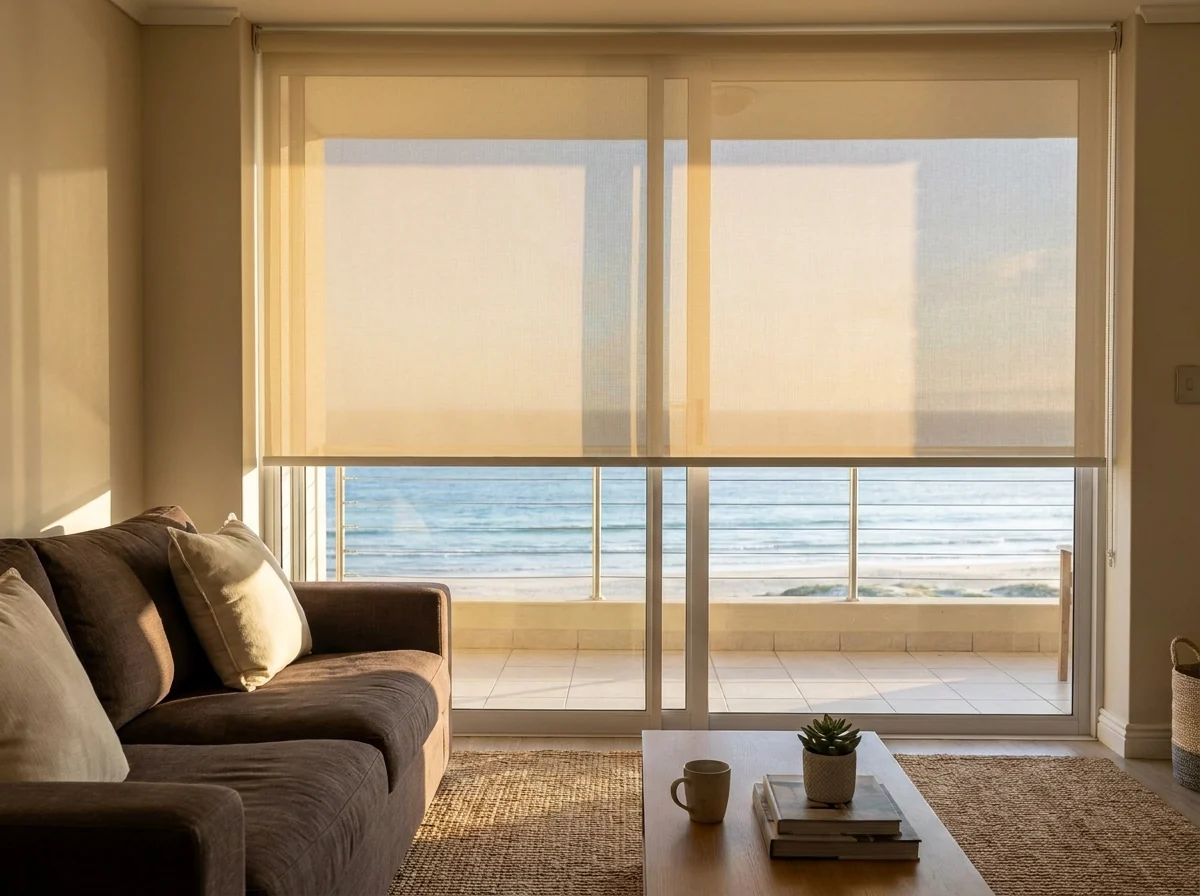
A screen fabric with a low openness factor across the whole opening, left down. A tightly woven sunscreen mesh cuts the field brightness dramatically while leaving the surf line and the sky perfectly readable through it. This is the single most useful thing on a Strand sea-facing window, and it is not a blockout product.
Light interior surfaces near the window. A dark wall next to a brilliant window is what makes eyes hurt. That is not something we sell; it is just true.
Something on the outside for the summer sunset hour specifically — which is section eight, and which is where the trustees come in.
Where blockout does belong
Bedrooms, and only bedrooms. Even there, understand that darkness is a fitting question more than a fabric one: every blockout fabric is opaque, so what wakes you at half past five in January is the light coming round the edges. A blind fitted inside a shallow aluminium reveal will always leak a bright hairline down each side; one fitted over the face of the opening, wider and taller than the glass, is markedly darker. On a beachfront flat with an east-of-south-east December sunrise, that difference is the difference between sleeping and not.
A pale sunscreen mesh across a sea-facing slider. The brightness drops; the beach stays where you can see it. That is the whole trick.Your side
Your side: what needs nobody’s permission
Anything fitted behind the glass, inside your own section, is ordinarily your decision and nobody else’s. That covers most of what a flat actually needs:
Sunscreen and blockout roller blinds, singly or as a double roller carrying mesh in front and blockout behind on one bracket — two answers, one set of fixings, which matters when you are drilling into an aluminium head.
Day/night banded blinds, where aligning the bands gives you a filtered view of the bay and offsetting them closes the room down at night.
Aluminium venetians in kitchens and bathrooms, where the tilt is useful and the salt-and-steam environment would destroy a natural material.
Cellular honeycomb blinds in a study or a bedroom against an exposed wall, where the trapped air in the cells does real insulating work.
Panel-track blinds across a wide slider, which stack clear of the opening instead of bunching in it.
Motorisation, which on a tall sea-facing window is less a luxury than a way of actually using a blind you would otherwise leave in one position all summer.
The one caveat: a scheme’s rules can still speak to what shows from outside — a bright fabric colour visible through the glass from the promenade, for example. It is rare, it is worth a two-minute check of your own scheme’s rules, and it is not the same thing as needing consent to fit a blind.
The opening
The slider is the flat’s real window
In most beachfront units the sea-facing wall is not a window at all. It is a large aluminium sliding door doing four jobs at once: the view, the light, the ventilation and the route onto the balcony. Every one of those constrains the shading.
It has to open while the blind is down
People forget this until the blind is installed. On a hot evening you want the mesh down against the low sun and the door open for air. A single wide roller manages that as long as the fabric hangs clear of the sliding leaf. A blind that traps the handle, or that the door catches every time it runs, gets pinned up within a fortnight and never used again.
Wide fabric behaves differently to narrow fabric
A very wide roller blind is an engineering item, not a bigger version of a small one: the tube must be sized so it does not deflect over the span, and fabric that behaves at 1.2 metres can drift sideways on the tube at three. Splitting a wide opening into two blinds on one continuous headbox is often the better answer — the join barely shows, each half is properly proportioned, and you can leave one side up for the door.
Or stop rolling it altogether
Panel tracks are the underrated answer on a very wide slider. Flat panels on a ceiling or face-fixed track slide sideways and stack tight against one end, so when they are open the opening is genuinely open rather than veiled. On a lounge whose entire purpose is the bay, that matters.
Stacked clear rather than rolled up: on a full-width slider this is often the difference between shading a view and hiding it.Wear
Grit in the track, film on the tube
Two things arrive at a Strand beachfront flat that do not arrive a kilometre inland, and they attack different parts of a blind.
Fine sand comes over the promenade on a windy day and settles in every horizontal groove it can find — bottom channels, track runs, the gap behind a headbox. Sand is abrasive: in a channel it grinds the coating off the running surface, and once the coating is gone the salt has a way in. That is the honest argument for keeping bottom channels off anything that does not strictly need one.
Salt film settles on everything, including inside a flat whose doors stand open to the sea for most of the year. It is why hardware on this frontage should be a grade better than an inland flat needs, and why a wipe of the brackets and bottom rail two or three times a year beats any warranty clause.
Neither is cause for alarm, and neither is a reason to buy the most expensive thing in the range. They are reasons to choose sealed over open wherever the choice exists: a cassette rather than an exposed tube, an enclosed headbox rather than bare brackets, a motor inside the tube rather than a chain hanging in salt air.
The line itself
Finding the line: how much reveal you actually have
On the older beachfront blocks the aluminium frame often sits almost flush with the internal plaster, leaving barely a reveal to fit into. On the newer, larger-glazed buildings there is usually more depth to play with, and sometimes a bulkhead or curtain recess above the slider that will swallow a headbox completely. That single dimension — wall face to glass face — decides more than anything else about how your blinds will look:
Deep enough to fit inside: the blind sits within the opening and the headbox is invisible from outside. It also leaks a light gap down each side, which matters in a bedroom.
Too shallow: the blind goes over the face of the opening instead. Darker, but it covers the frame and needs a fixing into the wall rather than the frame — in a concrete-framed block, a different job.
A recess above the slider: the best outcome, if the building gave you one. The fabric drops from a slot and the ceiling line stays unbroken.
We measure it at three widths and two heights on every opening, because a long block does not settle evenly and a slider that reads as square rarely is. That is the reason we will not quote from a photograph.
Their side
Their side: the balcony and the building’s face
Cross the glass and the rules change. Most of this beachfront is held in sectional title, and in a sectional title scheme the outside of the building is not simply yours to alter. A balcony is commonly an exclusive use area — yours to use, but still part of the scheme — and the facade itself is common property.
Schemes of this kind are governed by the Sectional Titles Schemes Management Act and the management and conduct rules made under it.3 Under the prescribed conduct rules, an owner or occupier must not change the external appearance of a section or of an exclusive use area without the written consent of the trustees — and that consent is not to be unreasonably withheld. Schemes are allowed to adopt their own rules in place of the prescribed ones, so your building’s registered rules are the document that actually governs you. Read them, or ask your managing agent for them.
Translated into shading, the practical position is:
Blinds inside the glass: generally your own decision, as in section three.
Anything bolted to a balcony wall, soffit, balustrade or the facade: awnings, screen channels, external slat systems, shutter headboxes — these change the external appearance and want the trustees’ written consent, obtained before the order rather than after the delivery.
Anything that penetrates common property: a fixing into a structural slab or a shared wall is a further step again, and some schemes require an engineer’s comment on the fixing.
We are not lawyers and this is not legal advice; the Act, the regulations and your scheme’s registered rules are the authority. What we do is hand you a specification, a drawing and a colour reference in a form the trustees can actually approve, rather than leaving you to describe a product you have not yet bought.
The premium tier
What goes outside when the answer is yes
It is worth pushing for that consent, because on a west-south-west summer sunset the external answers are not marginally better than an interior blind. They are in a different class, for a straightforward physical reason: fabric behind the glass can only deal with energy that has already crossed the pane. Stop the beam on the outside face and the glass never heats up in the first place.
The three we lead with on a Strand balcony
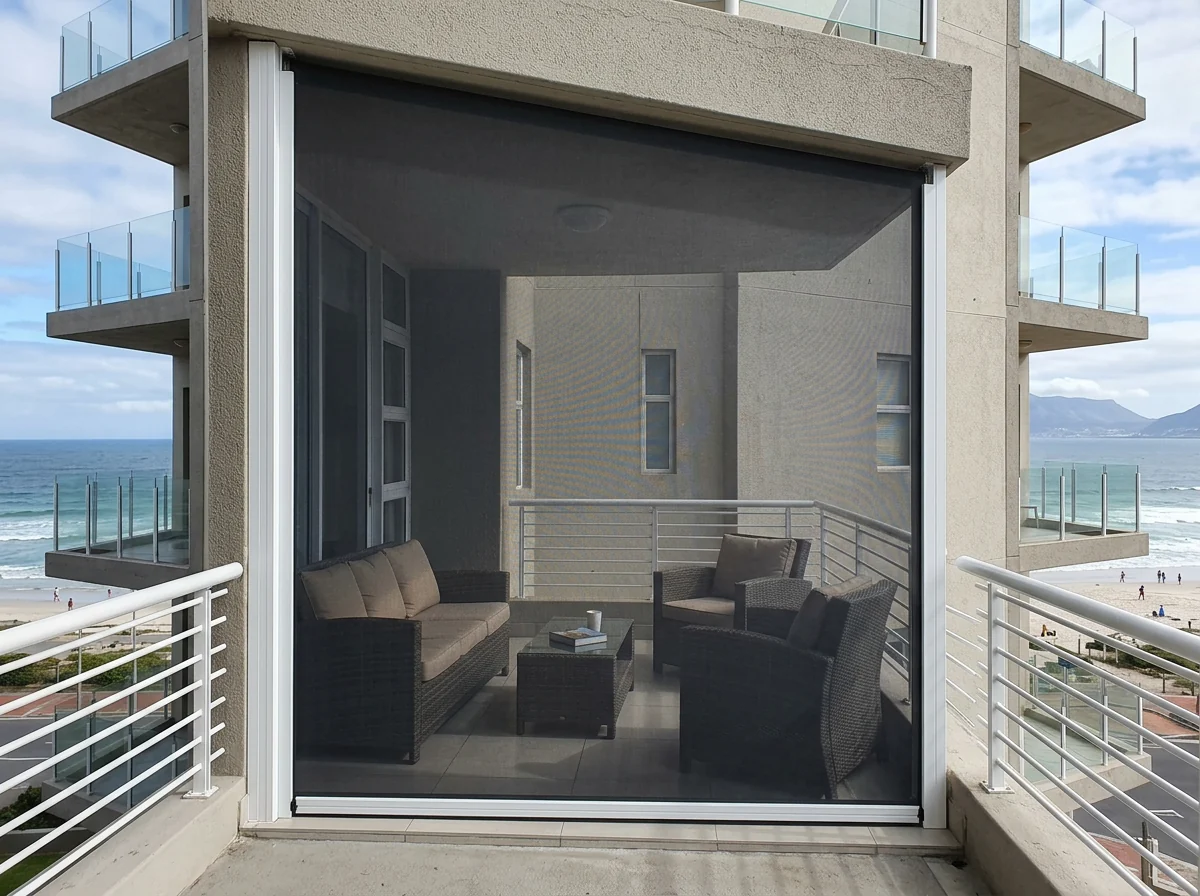
Zip screens. On an apartment balcony this is usually the strongest answer of the three. The mesh runs under tension inside side channels, so it holds its shape in wind that would flap a free-hanging blind, and dropped across the open end of a balcony it converts an exposed slab into a room you will actually sit on at six in the evening. The beach stays visible through it. It is also, from a trustee’s point of view, one of the easiest to approve, because a recessed channel in a matching colour reads as part of the building rather than an addition to it.
External venetian blinds. Aluminium slats mounted clear of the glass that both raise and tilt — so you can hold a low western beam off the pane while still looking under the slats at the water, and raise the whole thing out of the way through the winter months when your frontage does not need it at all.
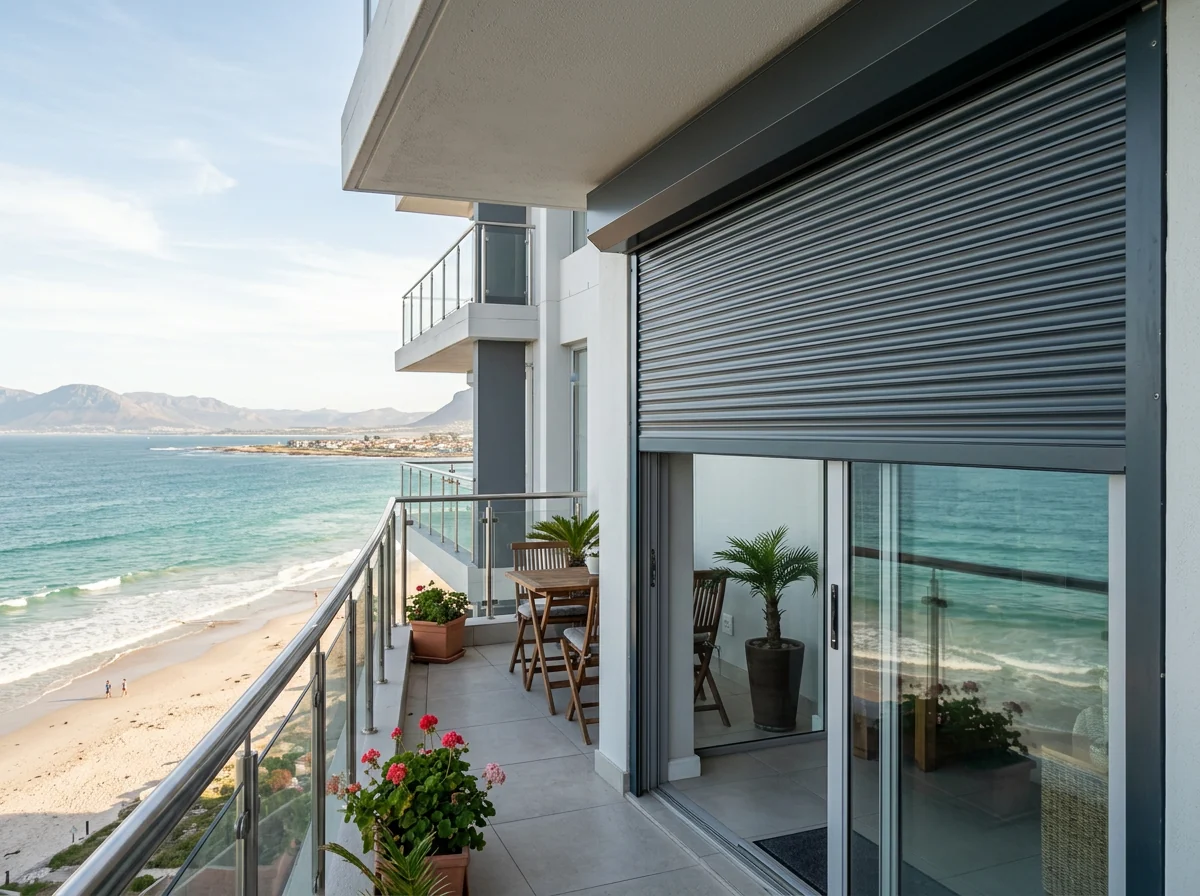
Roller shutters. Rigid slats rolling down over the opening from a headbox: the most complete of the three on heat, and useful against noise off a busy beachfront road as well. Worth being precise here — this is shading hardware. It handles sun, heat and glare and carries no security rating at all. If security is what you are after, that is a different product on a different quote.
The trade-off: all three cost more than an interior blind, all three fix to the outside of the building, and all three therefore go through section seven before they go anywhere near a fitter. Where consent genuinely is not available, a good low-openness sunscreen behind the glass is the honest second-best — cheaper, immediate, and measurably weaker on heat.
Tensioned mesh in side channels across the open end of a balcony — the sunset hour handled outside the glass, the view kept.A shutter run down outside the slider. Everything it stops, it stops before the glass — which is why it beats any fabric hung behind it.Wind
Height changes the wind
A ground-floor unit and an eighth-floor unit in the same block do not experience the same wind, and the difference is not small. South African wind-loading practice derives the design wind speed for a structure from the terrain around it and its height above ground, precisely because wind speed rises with height as the drag of the ground below stops slowing it.4 Higher balcony, faster air, bigger load on anything you hang there.
What that means in practice, on this frontage:
The higher you are, the more a channel-guided product wins. A screen held in side channels is restrained along both edges; a free-hanging blind is restrained at the top only. Above a certain height that stops being a preference and becomes the difference between surviving and not.
A folding-arm awning belongs on lower, sheltered balconies, and wherever it goes it should retract fully into a closed cassette with a wind sensor. Manual retraction depends on somebody being home and paying attention; the south-easter does not wait for that.
Corner units take it worst. Air accelerating round the end of a block hits a corner balcony harder than the middle of the same facade, which is why two identical units in one building can genuinely need different hardware.
Consent
Getting a scheme to agree
Trustees turn down applications for one reason far more often than any other: the building will end up looking like a patchwork. Nine different awning colours on nine balconies is a real problem for a body corporate and a fair thing for them to refuse. Almost every successful application we have been part of has worked around that objection rather than against it.
What tends to work:
Propose a standard, not an exception. Ask the trustees to approve one product, one colour and one mounting detail for the whole building, which any owner may then install at their own cost. You are no longer asking for special treatment; you are handing them a policy.
Bring a drawing and a colour reference, not a description. A dimensioned sketch of the headbox and channel, a powder-coat colour matched to the existing balustrade or window frames, and a product datasheet answer most of what a trustee is worried about before they have to ask.
Say what it looks like retracted, with a photograph. Much of the resistance is about the appearance on an ordinary day, and a slim recessed cassette in the building’s own colour is close to invisible from the promenade.
Get it in writing. Verbal approval from one trustee is not consent, and the person who inherits that problem is you, when you sell.
We supply the drawings, data and colour references free whether or not the job proceeds. We will not lodge an application in your name, and we will never tell you a consent is a formality.
The same detail repeated across a facade is what a body corporate can say yes to. One-off additions are what they refuse.On site
What the measure decides
Everything above can be worked out from a map, an almanac and a set of rules. These five cannot:
The real reveal depth at every opening, which decides inside fit against face fit and therefore how dark a bedroom can actually get.
What the wall is made of where a bracket has to go. Concrete frame, infill brick or drywall each take a different fixing, and on a balcony the answer is not always what it looks like.
Whether the slider still opens comfortably with the blind down, which is a question you answer by standing there and sliding it, not by measuring it.
Where the power is. A motorised blind on a sea-facing slider needs a socket within reach or a rechargeable tube you can actually get a ladder to.
What your scheme’s registered rules say, which is a document, not an assumption — and which we would far rather read before quoting than after fitting.
That is the honest reason the measure is free and unhurried. Every one of those five is cheap to establish beforehand and expensive to discover afterwards.
Next step
Book your free in-home measure
Tell us your building or street, which rooms face the water, and whether you are thinking about the balcony as well as the glass. One of our expert consultants will contact you shortly to arrange a free measure with fabric samples in hand.
No obligation, no call-centre — a consultant calls you directly
Drawings and colour references for your trustees, free either way
Written, itemised quote before anything is ordered
Sources
Where these facts come from
Every geographic, astronomical and legal claim above traces to one of the items below. The sunrise bearings in section one are our own arithmetic, mirroring the published sunset bearings across the north–south line, and are described as such. The product recommendations, the reflected-light diagnosis and the advice on approaching trustees are our professional opinion, not a finding, and nothing here is legal advice.
Wikipedia — Strand, Western Cape: the town’s position on the north-eastern shore of False Bay between Somerset West and Gordon’s Bay, and the run of its beachfront.
Gaisma — Cape Town sun and moon data: December-solstice sunset bearing near 240° and June-solstice sunset bearing near 297°, at the latitude that also serves Strand.
SAFLII — Sectional Titles Schemes Management Act 8 of 2011, together with the prescribed management and conduct rules made under it (Sectional Titles Schemes Management Regulations, 2016): the trustees’ written consent, not to be unreasonably withheld, is required before an owner or occupier changes the external appearance of a section or exclusive use area. A scheme may substitute its own registered rules, which then govern.
SANS 10160-3, Basis of structural design and actions for buildings and industrial structures — Part 3: Wind actions (South African Bureau of Standards): design wind speed is derived from terrain category and height above ground, wind speed increasing with height. Available through the SABS store.
Nothing on this page is legal advice, a structural opinion or a ruling on your scheme’s rules — those belong to your body corporate, your managing agent and a suitably qualified professional. This guide is free and reading it puts you under no obligation whatsoever.