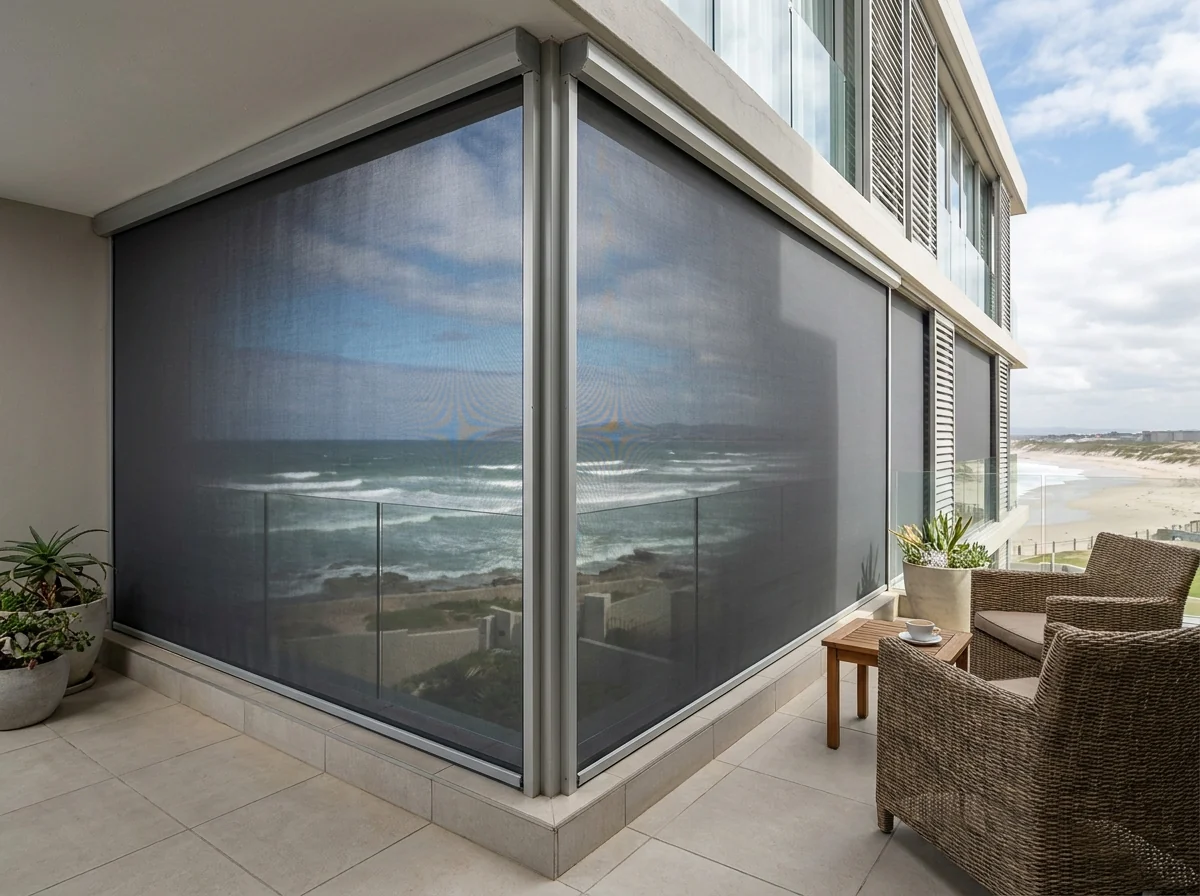
Why an ordinary drop screen fails on this beachfront
A screen without a zip runs loose in its guides and escapes them in real wind — exactly the condition Strand's beachfront delivers most afternoons. The zip welds the fabric edge into a zipper that locks captive inside the aluminium channel on both sides, so the screen holds its line under load instead of billowing and eventually pulling free. That's the entire difference between a screen that works here and one that doesn't.
What it actually does to the balcony
Lowered, a sunscreen-mesh zip screen cuts wind, glare and UV while keeping the ocean visible through the weave — closer to sitting behind a fine curtain than sealing yourself off. Inland the same mesh usually goes up for the glare on its own: on a Somerset West patio it drops down the open western side to stop the low sun sliding in underneath an awning at the end of the day. A clear PVC panel option seals the balcony properly against wind and rain when you want a usable outdoor room through a Cape winter, at the cost of the open-mesh view. Either fabric drops from a headbox and locks into side channels colour-matched to the building.
Sized and specified for direct beachfront exposure
Spans on this frontage often run wide — full balcony fronts and corner wraps are common on Strand's apartment blocks — so we motorise as standard past a certain width and fit a wind sensor for automatic retraction ahead of a strengthening gust. That sensor is just as non-negotiable on the wind-exposed slope above Gordon's Bay, where the coastal view lengthens and the gusts get more serious along with it. Salt spray and airborne sand both reach these balconies on a windy day, so channels and hardware are specified in powder-coated, seaside-rated aluminium rather than a standard interior-grade finish. As with an awning, an external screen bracket on a sectional-title balcony usually needs body corporate consent before it goes in — we check at the first call.
What a zip screen costs
Pricing goes by the square metre of screen, installation included: R2,800 – R4,500 hand-operated, rising to R4,000 – R6,000 motorised. Almost all of the difference between a zip screen and an ordinary outdoor blind is in the side tracks the fabric zips into and the fixings that keep it steady when the wind comes off the water.
On an exposed balcony the motor and the wind sensor earn their place ahead of extra size. Small openings carry a minimum charge. Every screen carries a stated wind rating, and we give you that number at the measure rather than a comfortable generalisation, together with the real per-opening price in writing.
- Sunscreen mesh or clear PVC fabric options
- Zipped aluminium side channels, no flapping in wind
- Motorised standard on wide balcony spans
- Wind-sensor auto-retract for exposed positions
- Body corporate sign-off usually required — we ask upfront
Ready to measure your balcony?
The measure at home is free, the quote is written window by window, and you are committed to nothing.
