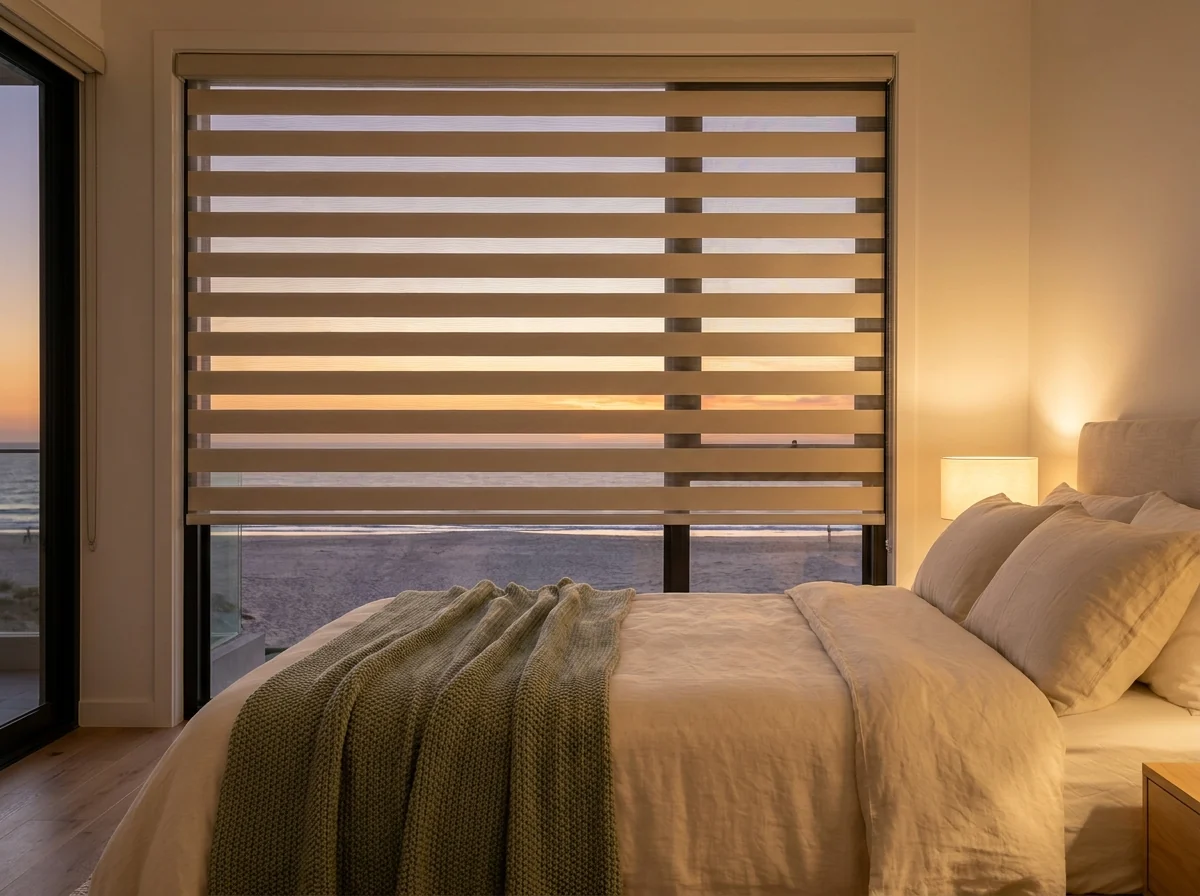
One blind, two very different jobs
A day/night blind alternates sheer and solid horizontal bands on a single loop. Align the bands and light filters through the sheer sections while the solid bands soften the glare — good for a lounge that wants a view of the water without the full brightness of an open sunscreen. That first setting is the one that travels inland as well: on a Somerset West lounge looking up at the Helderberg, the same band alignment keeps the garden view and takes the hard edge off a summer afternoon. Offset the bands and the solid sections overlap the sheer ones almost completely, giving near-solid privacy without lowering a second blind — the answer for a ground or first-floor unit close to the beach path, where people walk past at eye height all day.
Why beachfront units reach for this over a plain roller
Strand's promenade and beach access run right along the front of most blocks, so a lounge or bedroom window at low level gets looked into more than an equivalent window inland would. A day/night blind solves that without committing to permanent net curtains or a fully blocked-out room during the day — you set the band position to match how exposed the window feels at that hour, then adjust again in the evening once the lights are on inside and the street is dark outside.
Fit and care on this frontage
Standard roller hardware carries the fabric — chain or motorised, cassette or open bracket, inside or outside mount. The sheer bands are less rugged than a solid roller fabric, so we don't recommend day/night blinds for a window that gets direct wind-driven salt spray; they suit inward-facing rooms or units set back from the immediate spray line better than a full glass wall on the water. That is why the sheltered harbourside streets of Gordon's Bay take this blind comfortably where the exposed slope above them often will not: the range behind keeps enough wind off them that glare, rather than spray, is what a window there has to answer. Chain tensioners are fitted as standard, and cordless or motorised control is the better call for a nursery or child's room.
What a day-night blind costs
Take these as installed rates for each square metre. Manual day-night blinds run R1,300 to R2,000 per square metre. involves more work than a straightforward roller, which explains why the range starts higher; width, the weight of the solid stripe and whether a cassette conceals the tube all move the figure within it.
Add a motor and you are looking at R2,800 to R4,000 per square metre. It is often worth it here, because the value of the product is in small, frequent adjustments as the sun swings from one end of the day to the other, and a blind that is a stretch to reach quietly stops being adjusted. Small openings carry a minimum charge, and the binding number follows the free measure.
- Alternating sheer and solid horizontal bands
- Light-filtering to near-blockout band fabrics
- Chain or motorised control, cassette optional
- Best suited to inward-facing or spray-sheltered windows
- Not a true blockout — pair with a blockout roller for total dark
Ready to measure your glass?
The measure at home is free, the quote is written window by window, and you are committed to nothing.
