Home / Products / Roller Blinds
Roller blinds built for the glare bouncing off the water
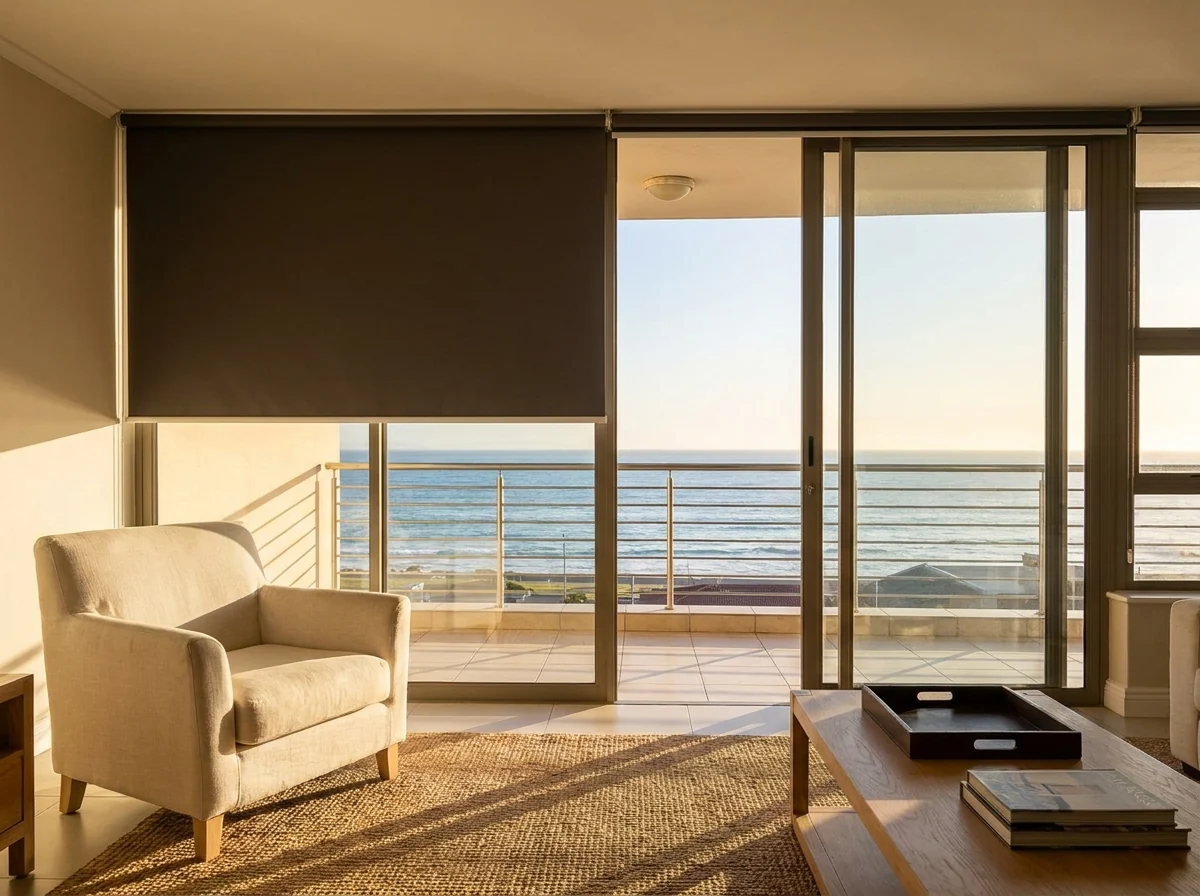
Sunscreen, blockout and double-roller fabrics, made to measure for Strand's beachfront glass — with the mesh openness and salt-air hardware chosen for a coastline that catches direct sun and salt every day of the year.
Sunscreen does the daily work
On a lounge that faces the beach square-on, a fine sunscreen mesh — usually 3–5% openness — is the roller most Strand units end up drawing every afternoon. It keeps the line to the surf and the sand while cutting the glare bounced straight back up off the water. Lower percentages block more heat and glare at the cost of a softer view; most beachfront lounges land at 3–5%, though top-floor units catching the sun square-on sometimes want it lower again. Inland the mesh is answering a longer exposure than a glare bounce: the fairway-facing glass at Erinvale takes hours of uninterrupted afternoon sun with nothing but open grass in front of it, so the openness we settle on there is as much about heat as it is about the view.
Blockout, and the double-roller answer for bedrooms
Bedrooms want the opposite problem solved — full dark, regardless of what the promenade lights are doing after sunset. A single blockout roller does that on its own. A double roller (day/night) pairs a blockout fabric with a sunscreen on the same bracket, so the room gets a filtered sea view by day and total privacy at night without swapping blinds. Blockout fabric also works as a genuine thermal layer, taking the edge off a unit that traps heat in summer and loses it fast once the wind gets up in winter. Fitted inside the existing frame it changes nothing an outsider can see, which is what makes it workable on the heritage-overlay homes in central Stellenbosch, where a street-facing elevation can't be altered without heritage-committee sign-off.
Fitted for a south-facing coastline that still catches the sun
Strand's beachfront units mostly face south across False Bay — shaded through the middle of the day, but not at the edges of it. Cape summer pushes sunrise and sunset well south of due east and west, so that "shaded" south wall still takes direct, low sun for the first and last hour of daylight. We size sunscreen and blockout rollers for that dawn-and-dusk exposure rather than assuming a south aspect needs nothing. Chain and cord tensioners are fitted as standard on anything corded, and near a balcony door we lean towards battery motorisation and a sealed cassette rather than an open bracket — what actually survives salt spray and fine airborne sand on this frontage.
What a roller blind costs on this beachfront
Guides per square metre, installed. On a chain or a spring, in any of the three fabrics, expect R1,000 to R1,600 per square metre. The bottom of the band is a stock-colour blockout; the top is a fine-weave sunscreen in a wide fabric, or a double bracket doing two jobs on one window.
With a tube motor fitted, the range is R2,500 to R3,800 per square metre — motor, control gear and the setup done on the day, all in. Small windows carry a minimum charge, since the brackets, tube and installer time barely change with size. None of that is a quotation. The figure you can rely on is the one set against each window once the measure is done.
- Sunscreen mesh, 3%, 5% or 10% openness
- Blockout fabric for bedrooms and media rooms
- Double roller (day/night) on one bracket
- Chain, spring or battery-motorised control
- Sealed cassette option for exposed positions
Ready to measure your glass?
The measure at home is free, the quote is written window by window, and you are committed to nothing.
